Existing home sales have slowed meaningfully since 2022, but the decline appears to be driven more by limited housing supply than by a lack of buyer demand.
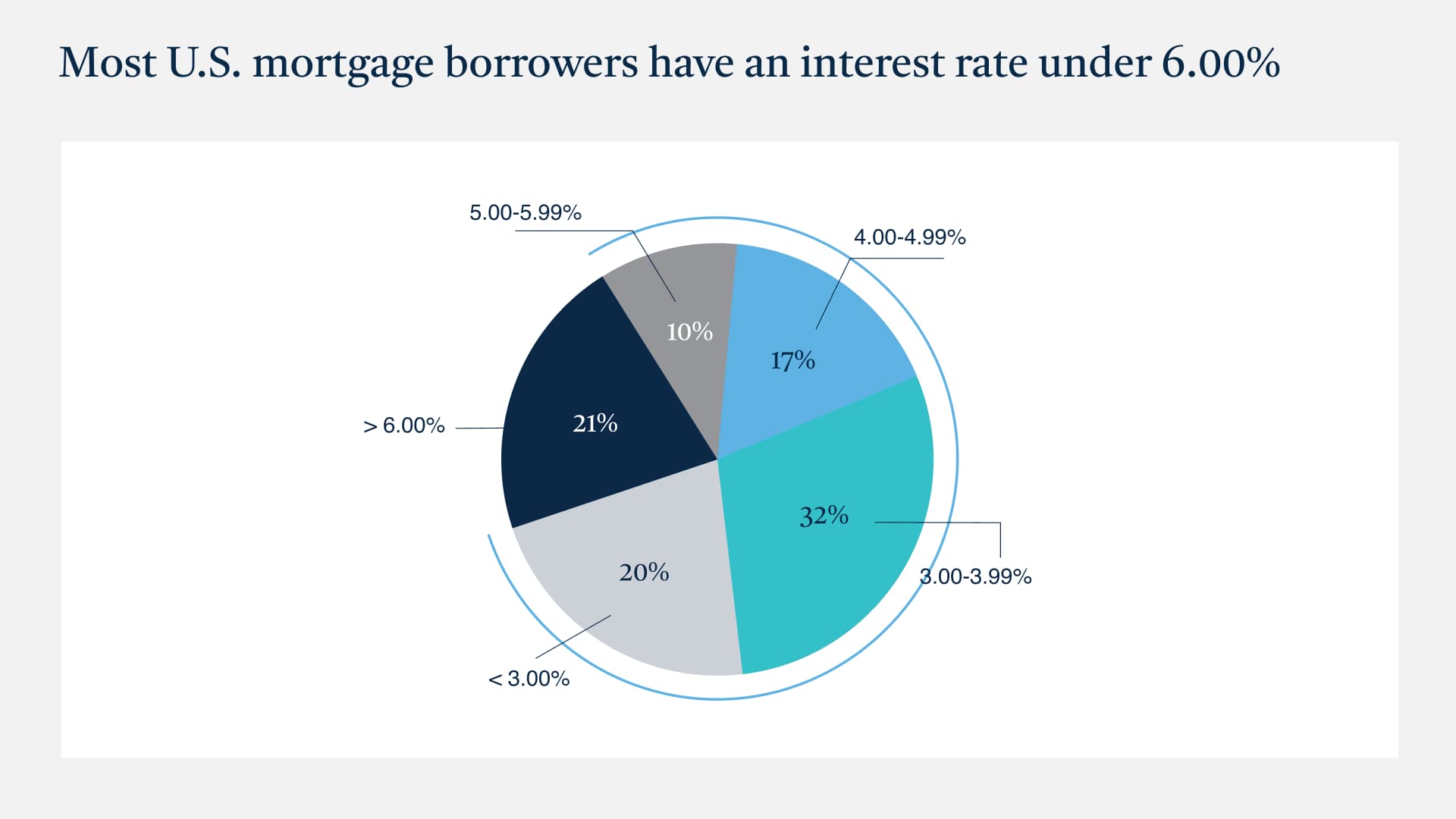
According to Federal Housing Finance Agency (“FHFA”) National Mortgage Database data, approximately 79% of U.S. mortgage holders currently have mortgage rates below 6%.(1) Many homeowners secured historically low rates during 2020–2021 and have remained reluctant to sell and replace those mortgages with today’s higher financing costs. This “lock-in” effect has contributed to lower housing turnover and constrained resale inventory.
In addition to constrained housing supply, the age of the U.S. housing stock continues to create a long-term need for renovation and retrofitting activity.
According to the American Community Survey, approximately 50% of U.S. housing units were built before 1980, with the median home nationally built in 1980.(2) In certain regions, housing stock is materially older — including the Northeast, where approximately 68% of homes were built before 1980 and the median home was built in 1964.(2)
Older housing inventory often requires modernization, deferred maintenance, energy-efficiency improvements, or layout modernization to meet current buyer preferences. As a result, aging housing stock continues to support demand for renovation activity even during periods of slower existing home sales.
This dynamic is particularly relevant in markets where limited new housing supply increases the importance of rehabilitating existing inventory.
Existing housing inventory continues to represent the overwhelming majority of housing transactions in the United States. As a result, the functionality, modernization, and repositioning of existing homes remain increasingly important in a market where new supply additions continue to face affordability and construction-related constraints
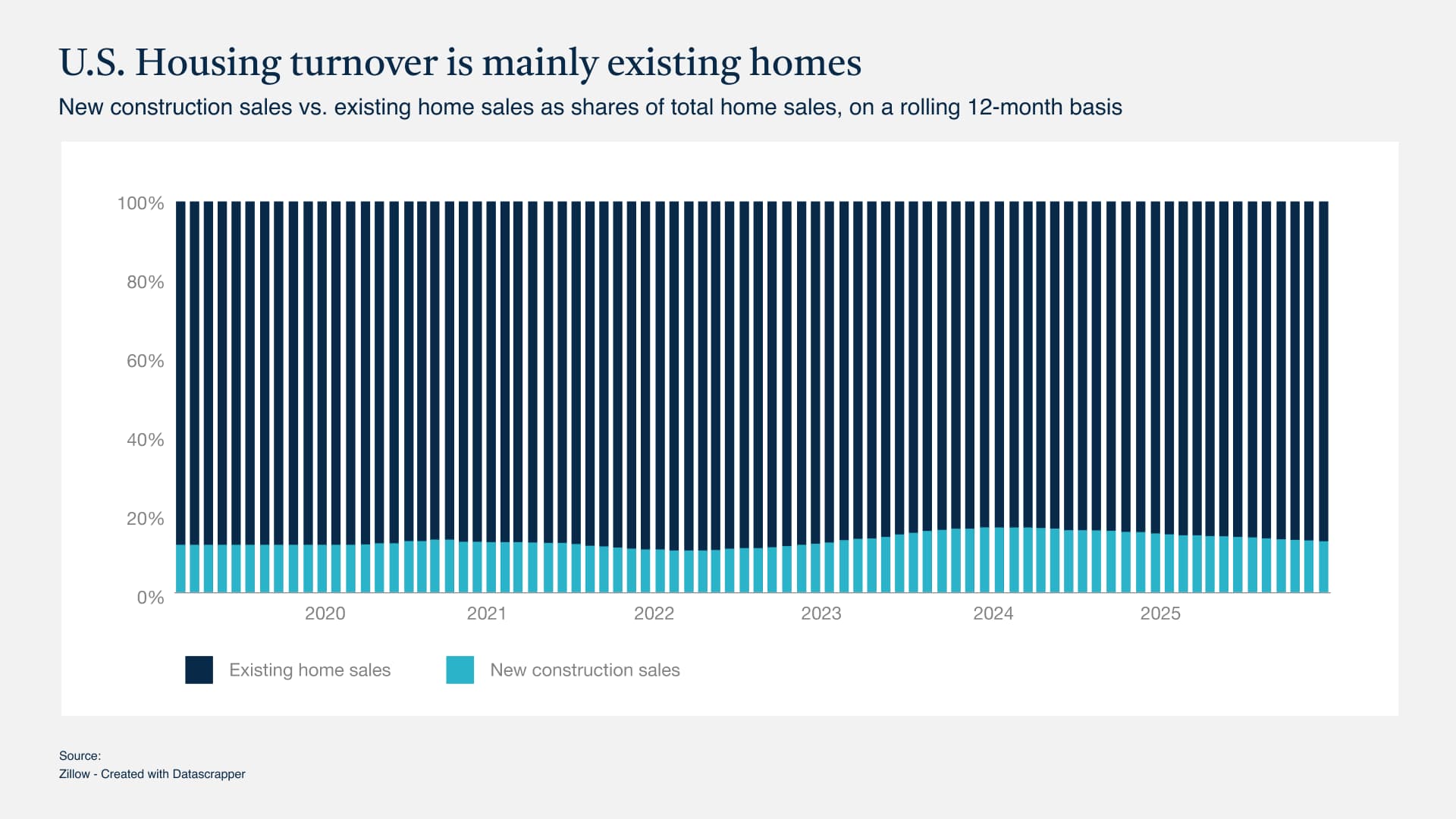
This dynamic helps explain why renovation activity and move-in ready housing inventory continue to play an important role even during periods of slower overall home sales. In many local markets, existing inventory remains the primary mechanism through which housing demand is absorbed and housing stock is functionally updated. In a market with limited supply, renovated and move-in ready homes continue to address demand from buyers seeking immediate occupancy without additional renovation work or construction timelines.
Investor participation has also remained active despite lower transaction volumes. According to a report published by Cotality, investor purchases represented nearly 30% of residential home sales at the close of 2025.(3) Continued investor activity suggests ongoing demand for residential inventory despite slower overall market turnover.
Residential transition loans (“RTLs”) are short-term loans typically used by investors and developers to acquire, renovate, stabilize, or construct residential properties prior to sale or refinancing. Because repayment is generally tied to successful project completion and property disposition, RTL performance can provide a useful indicator of underlying housing market liquidity and demand for renovated or newly constructed homes. In periods where exit conditions weaken materially, extension activity and loan resolution timelines would generally be expected to deteriorate.
Roc360’s internal residential transition loan performance data has generally reflected stable project execution trends throughout this period. Historically, approximately 30% of renovation loans have extended beyond their original stated maturity, and extension approval rates have remained relatively consistent over time, including through the recent higher-rate environment.(4)
The modest increase in approved extensions during 2024 primarily reflects a larger concentration of infill construction projects, which typically require longer completion and sale timelines.
Similarly, historical payoff trends for Roc360 residential transition loans (“RTLs”) continue to track in line with prior periods. Recent loan vintages originated after 2024 have shown improved payoff activity relative to certain earlier periods.
While overall housing transaction volumes remain below prior-cycle highs, current market data and historical residential transition loan (“RTL”) performance trends suggest that renovated and newly constructed housing continues to transact within expected timeframes in a supply-constrained market. The combination of limited resale inventory, the mortgage “lock-in” effect, and an aging U.S. housing stock continues to support demand for updated, move-in ready homes. Importantly, historical RTL extension and payoff trends have remained broadly consistent through the recent higher-rate environment, indicating that project completion and property disposition activity has generally remained stable despite slower overall housing turnover. While today’s market is more selective than the exceptionally active 2020–2021 period, current conditions continue to support renovation and infill housing activity in markets where existing inventory requires modernization and new supply remains limited.
- Source: Federal Housing Finance Agency National Mortgage Database (NMDB), Q3 2025 data, published December 30, 2025.
- Source: American Community Survey, published January 2026, representing 2024 data.
- Source: Cotality, February 12, 2026.
- Source: Roc360 historical loan extension data, 2014–2024.