
As institutional investors continue to expand allocations across private credit and real assets, residential investment property finance is becoming increasingly relevant within the broader U.S. housing ecosystem.
The opportunity is supported by several long-term structural characteristics of the market: the scale of U.S. residential housing, persistent housing supply constraints, the importance of existing housing inventory, and the growing role of private capital in financing residential investment activity.
Residential mortgages represent approximately $14.5 trillion of outstanding credit in the United States, making housing one of the largest credit markets globally1. At the same time, large portions of the financing ecosystem supporting residential renovation, bridge lending, rental property finance, and new single-family residential construction continue to operate through highly fragmented and localized markets.
For institutional investors, this creates an opportunity to evaluate segments of residential credit that are closely connected to long-term housing demand, asset-backed collateral, and localized supply dynamics.
Residential Housing Represents a Large and Durable Credit Market
Residential real estate occupies a uniquely important position within the U.S. economy. Housing serves not only as a long-duration real asset and source of household wealth creation, but also as one of the deepest collateral markets globally.
Institutional participation across residential credit has historically concentrated around agency mortgage-backed securities and public homebuilders. However, a broader financing ecosystem continues to support housing renovation activity, transitional lending, smaller-scale rental operators, and local residential development across many markets.
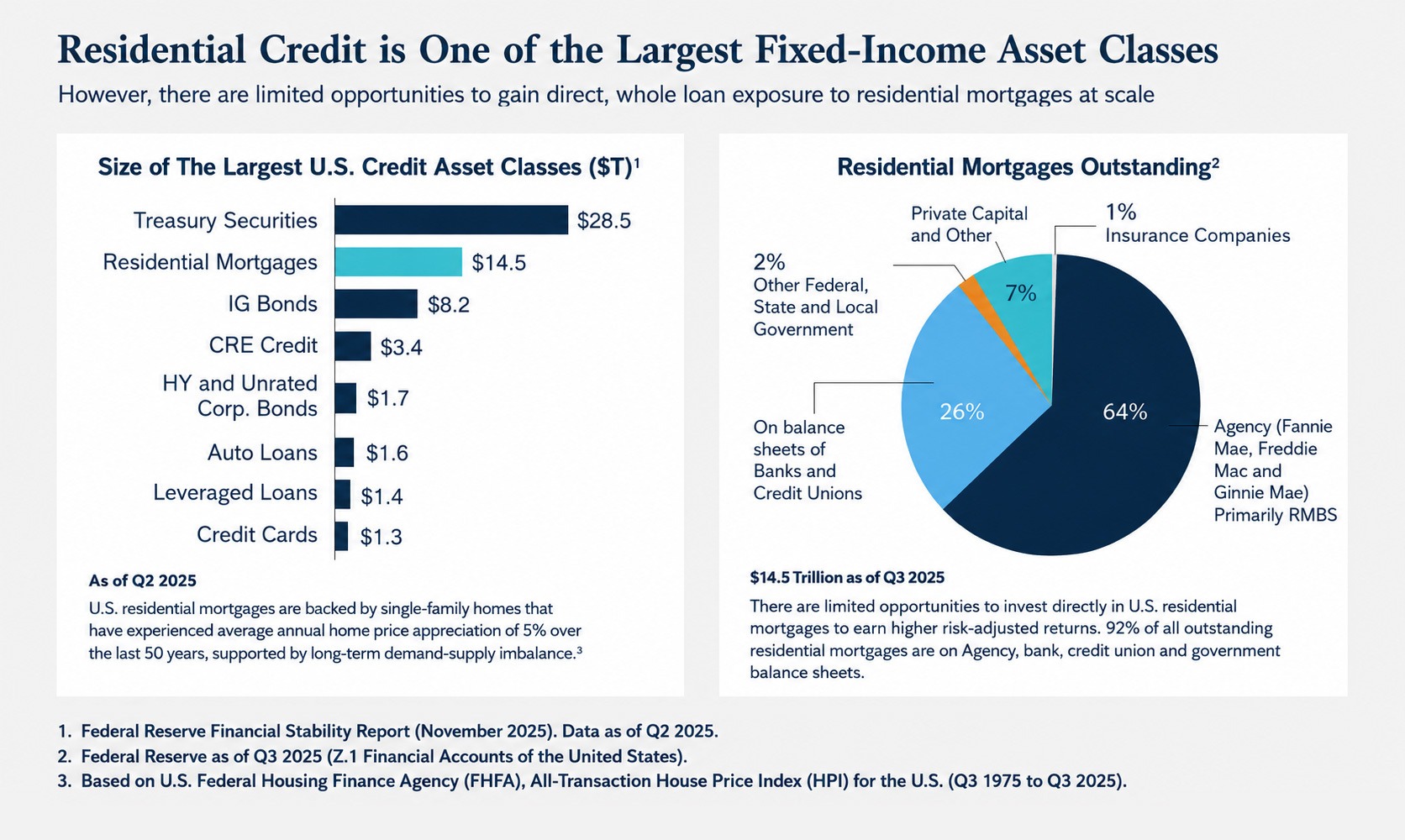
As institutional portfolios continue to evolve across private credit and alternative income strategies, residential investment property finance is increasingly being evaluated through the lens of market structure, collateral quality, and long-term housing demand.
Fragmentation Continues to Shape the Market
One defining characteristic of residential investment property finance is the fragmented nature of the underlying market.
Unlike many traditional commercial real estate sectors that involve larger assets and concentrated ownership structures, residential investment activity in the United States remains highly distributed across local operators, smaller investors, and regional developers.
Approximately 94% of single-family rental ownership remains held by small and medium-sized investors, while institutional owners with more than 100 properties account for only approximately 6% of the market2.
This market structure creates operational complexity, but it also contributes to a financing environment that often requires specialized underwriting, localized market expertise, and active collateral management capabilities.
For institutional investors, the significance of this fragmentation lies in the ability to access diversified residential credit exposure tied to local housing activity rather than concentrated exposure to a limited number of large assets.
Residential Investment Property Finance Differs From Traditional Mortgage Exposure
Institutional investors evaluating residential credit opportunities today are increasingly distinguishing between traditional agency mortgage exposure and business-purpose residential lending tied to investment property activity.
Agency mortgage-backed securities continue to provide liquidity and standardization. Business-purpose residential lending, however, typically involves shorter-duration financings secured by first-lien residential collateral and underwritten based on property economics, renovation budgets, rental cash flows, or project completion assumptions.
The structure of today’s residential investment property lending market also differs materially from the pre-2008 non-agency residential lending environment that many investors continue to associate with residential credit risk. Contemporary business-purpose lending generally involves lower leverage structures, professional investor borrowers, asset-level underwriting, and more active collateral oversight.
As residential private credit continues to evolve, these distinctions are becoming increasingly relevant within broader institutional discussions around asset-backed finance and alternative income generation.
Housing Supply Dynamics Continue to Support Financing Demand
The U.S. housing market continues to face structural supply constraints across many attainable housing segments. Years of underbuilding following the Global Financial Crisis, combined with higher construction costs, labor shortages, zoning restrictions, and tighter bank financing conditions, continue to affect housing supply dynamics across many regions.
Much of the activity addressing these supply gaps occurs through existing housing inventory rather than large-scale new construction. The median age of owner-occupied homes in the United States now touches 50 years, reflecting the continued aging of the nation’s housing stock3. As a result, renovation activity, property modernization, deferred maintenance improvements, and rental stabilization continue to represent important components of housing market functionality across many local markets.
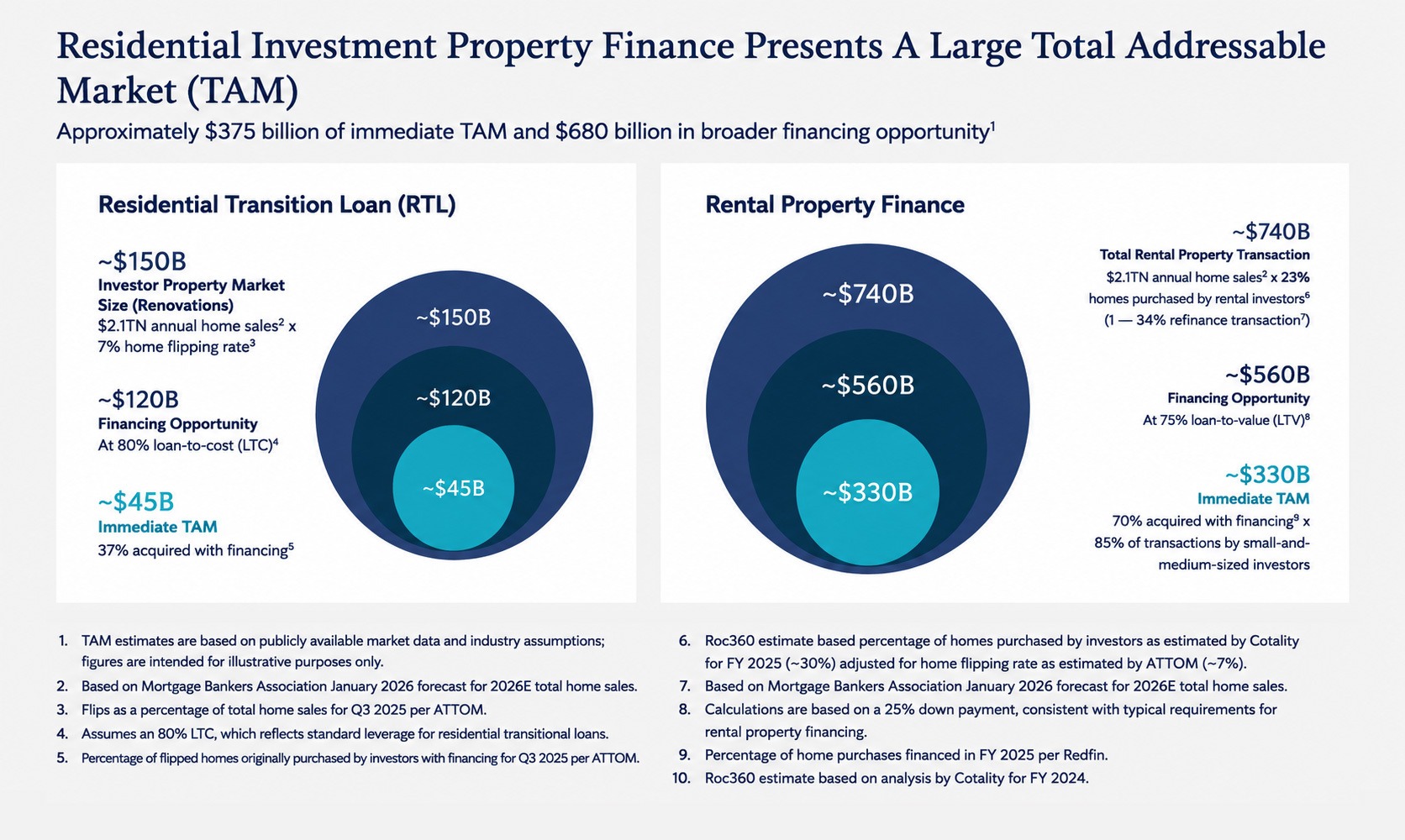
The scale of financing activity tied to residential investment properties reflects the breadth of this market. Within residential transition lending, which includes financing for property acquisition, renovation, and resale activity, an immediate addressable market opportunity of approximately $45 billion within a broader financing ecosystem of roughly $120 billion is estimated. On the rental property finance side, which includes acquisition and refinancing activity tied to residential rental properties, the immediate addressable market is estimated at approximately $330 billion within a broader financing opportunity approaching $560 billion. Together, these segments represent a large and highly fragmented financing market connected to existing housing inventory, smaller-scale residential investors, and localized housing activity across the United States.
Local builders, residential investors, and renovation operators frequently rely on financing ecosystems operating outside traditional conforming mortgage channels. As traditional banks continue to operate under tighter regulatory and balance-sheet constraints, private capital continues to play an increasingly important role across several segments of residential investment property finance.
The Opportunity Increasingly Lies in Market Structure
The institutional relevance of residential investment property finance increasingly lies in market structure rather than short-term housing market speculation.
The U.S. residential ecosystem remains large, operationally intensive, and deeply connected to long-term housing demand across local markets. Existing homes continue to account for approximately 90% of total U.S. home sales, highlighting the importance of financing ecosystems tied to renovation activity, transitional housing finance, smaller-scale residential development, and rental property stabilization4.
These conditions continue to create segments of the market where institutional investors may gain exposure to asset-backed residential credit supported by diversified collateral pools, localized underwriting, and durable housing demand fundamentals.
As institutional portfolios continue to evolve across private credit and alternative income strategies, residential investment property finance increasingly warrants deeper institutional evaluation. For many investors, the relevance lies not only in the scale of the market itself, but also in the ability to access highly fragmented and operationally intensive segments of residential credit that may offer differentiated, asset-backed exposure tied to long-term housing demand, localized underwriting dynamics, and the potential for attractive risk-adjusted returns.
Importantly, much of this activity remains highly fragmented and operationally intensive, often requiring localized underwriting expertise, active asset management, and specialized servicing capabilities. For institutional investors, this creates exposure to financing activity connected to long-term housing demand and property-level collateral rather than purely transaction-driven housing cycles.
Conclusion
Residential investment property finance continues to represent an important and evolving segment of the U.S. credit ecosystem.
The market’s localized and operationally intensive nature has historically limited broad institutional participation outside standardized mortgage channels. Yet those same characteristics continue to shape a financing ecosystem supporting housing renovation, transitional lending, rental property finance, and smaller-scale residential development across the country.
For institutional investors, the relevance of the sector increasingly extends beyond housing market exposure alone. It reflects a broader intersection between residential collateral markets, private credit, and long-term housing supply dynamics.
Roc360 explored several broader housing themes in greater detail in its July 2025 white paper, Attainable Housing: A Resilient Asset Class Backed by Real Impact.
1.Federal Reserve Financial Stability Report (November 2025). Data as of Q2 2025.
2. Source: John Burns Research & Consulting, Single-Family Rental Analysis and Forecast, published September 2025.
3. U.S. Census Bureau, American Community Survey; National Association of Home Builders analysis
4. National Association of Realtors; U.S. Census Bureau